Research Library
Movement, independence and meaningful living
Explore the evidence informing Vida Eterna: what researchers have found, where uncertainty remains, and how findings relate to everyday physical capacity.
The Vida Eterna Research Library shares published research on movement, exercise, and health for general information and education. Its content is not intended to diagnose or treat any health condition or to replace professional care. For advice about your health, consult a qualified healthcare professional. The cited studies did not evaluate or validate the Vida Eterna methodology.
Exercise, Mental Health, and the Brain: What Does the Science Tell Us?
Recovery Is Part of Performance
The finish line marks the start of recovery. After a hard race, how soon does it make sense to pick up the pace again? A 2026 MRI study offers a look at what happens in the first three days after a half marathon.
What the researchers found
Zhou and colleagues assigned 24 recreational male runners, ages 20 to 50, to rest, moderate running, or high-intensity running after a half marathon. MRI scans tracked changes in thigh muscles from before the race through 72 hours afterward.
By the 72-hour scan, one MRI measure had returned to its pre-race level in the rest group. It had recovered only partly in the moderate group and showed no recovery in the high-intensity group. A second MRI measure showed a similar pattern.
What this means for the next run
The findings give runners a reason to leave room for recovery before adding another hard effort. The study was small, followed runners for three days, and measured changes on MRI. It did not establish when runners were ready to train again, whether easy activity would help, or how the results apply to women, older runners, or people recovering from a full marathon.
For athletes thinking beyond the next race, recovery deserves a place in the training plan. The goal is to keep building the capacity to move, compete, and enjoy life for years to come.
What happens to your tendons after a hard run as you get older?
Open the tendon article on its own page
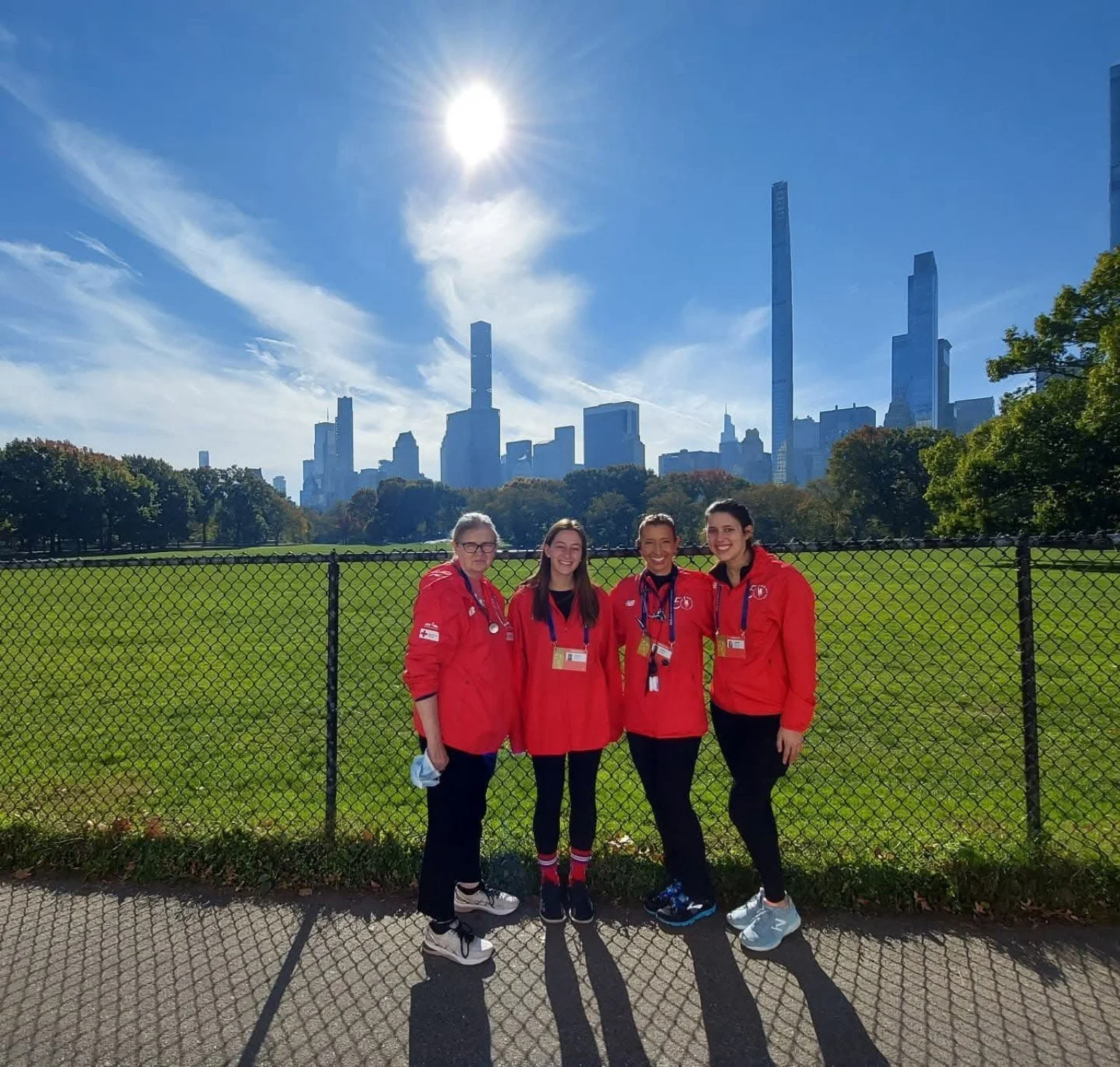
After the New York City Marathon, Vida Eterna founder Monica Sanchez was thinking about how to ease back into running. It’s a familiar question after a race, a long run, or a hard hill session. The research offers a way to think about recovery, even though it can’t tell us exactly when to schedule the next hard effort.
A hard run can change collagen activity around a tendon
Tendons transfer force from muscle to bone. Collagen is a major part of the structure that lets them do that. Remodeling involves making, breaking down, and reorganizing components of that structure. Each study captures a different part of this process.
In a small study of seven trained runners, Langberg and colleagues measured a marker of new type I collagen formation in fluid around the Achilles tendon after a 36 km run. The marker was higher at the 72-hour sample than at baseline. A later controlled study found that a related marker also rose at 72 hours in people who did not run, raising the possibility that the sampling procedure contributed to the result. It stayed elevated at 96 hours in the running group. These are observations at specific sampling times. Neither study measured when older runners regained the ability to tolerate another hard run. Langberg et al., 1999 · Olesen et al., 2007
Miller and colleagues used labeled amino acids and tissue samples to measure synthesis in the patellar tendon and thigh muscle separately after exercise in young men. Tendon collagen and muscle proteins both responded, but a muscle measurement can’t stand in for a tendon measurement. A different study used radiocarbon dating to estimate long-term turnover and found very limited renewal in the core of the adult Achilles tendon. Short-term synthesis in a sampled region and long-term replacement of the tendon core answer different questions. Miller et al., 2005 · Heinemeier et al., 2013
What studies in older adults actually tell us
Couppé and colleagues compared lifelong male runners averaging 64 years old with untrained men of similar age. The runners had fewer of one type of age-related collagen cross-link in their patellar tendons. This was a snapshot of groups with different training histories. It did not track recovery after a workout. Couppé et al., 2014
In a separate intervention, Reeves and colleagues found that the patellar tendon became mechanically stiffer after 14 weeks of strength training in older adults who were not masters runners. Here, stiffness means the tendon stretched less for a given load. It’s a measured mechanical property, distinct from the sensation of feeling stiff. The study shows that tendons can respond to repeated loading in later life. It gives no timetable for recovery between hard runs. Reeves et al., 2003
Crossland and colleagues sampled patellar tendons from initially untrained men averaging 24 or 69. After four weeks of resistance training, tendon protein synthesis increased, with no detected difference in that response between age groups. Some gene responses were smaller in the older group. The study measured synthesis over weeks and did not test recovery after a single intense run in trained older athletes. Crossland et al., 2023
Training adaptation and injury repair are different situations
Training adaptation is a change in how tissue responds to repeated demands. Injury repair is the response to tissue damage. A collagen marker after a run doesn’t establish that the tendon was injured, how much load it can handle next, or whether an existing injury has healed. Results from the Achilles and patellar tendons also don’t establish a timetable for another tendon, such as the proximal hamstring.
How to use this in real life
A practical inference is to compare the effort with what you’ve been tolerating recently. A first long downhill run asks something different of you than a familiar easy loop. Consider how stairs, walking, or your usual easy movement feel before layering in another demanding session. If focal pain is worsening, changing your stride, or repeatedly limiting normal movement, get it assessed before treating it as routine recovery.
The goal is to build the capacity to keep moving, whether that means running again, walking all day on a trip, or taking the stairs comfortably. These studies support paying attention to the load and your response over time. They don’t establish a universal extra day of rest for older athletes.
The Reverse Taper
A week after running the New York City Marathon, I’m in the same phase as many runners: easing back into movement and giving myself time before I train again. Watching how elite runners recover offers a useful perspective. Some take two full weeks away from running after a major race. Even athletes who run for a living make room for rest.
What runners and coaches do
Public training logs show examples of elite runners taking about two weeks off after a marathon. These are individual examples, so they can’t tell us what most elite runners do or which approach works best.
One approach, described in the RunnersConnect guidance from coach Jeff Gaudette, is to keep any early return to jogging brief: 15 minutes or less at an easy pace, every other day, with daily running waiting until after two weeks. The early jogs are for easing back into movement. Other coaching plans suggest taking the first 7–10 days off running or sticking to very light activity. Walking, easy cycling, gentle yoga or the elliptical are options if they feel comfortable.
How to think about the timeline
Feeling less sore and being ready to handle a hard workout are different milestones. Some coaching plans use two to three weeks as a starting point for bringing back intensity or meaningful mileage, and two to four weeks as a broad recovery window. These are coaching estimates rather than proven deadlines. If discomfort is worsening or changing how you walk or run, get it assessed before adding load.
Recovery is part of lifelong movement
At Vida Eterna, the goal is to preserve the capacity to keep doing what you love. After a marathon, that can mean walking today so you have room to build back toward running. The same principle applies whether you want to race again, hike with friends or stay active and independent: let how you respond to movement guide the next step.
Coaching perspectives and training-log examples
Getting Older, Staying Capable
As a physical therapist and endurance athlete, I care about what movement allows us to keep doing: exploring a new city on foot, carrying our own bags, taking the stairs, or joining friends for a ride.
That is why a recent study of older cyclists caught my attention.
Published in GeroScience on September 28, 2026, it followed 82 returning cyclists over nine years. At follow-up, they were 64–86. Aerobic capacity declined, yet almost all completing exercise testing ranked at or above the 90th percentile of reference fitness values. Lean tissue also decreased.
Age and capacity tell different stories
A birthday tells us how long we have lived. It does not tell the whole story of what we can do today or what we want to keep doing.
For me, this research is a useful invitation to reconsider the questions we ask about aging. Instead of asking only, “How young can I stay?” I would rather ask:
- What activities make my life meaningful?
- What physical abilities do those activities require?
- How can I make movement a consistent part of protecting those abilities?
My interest is in the relationship between physical capacity and freedom. A race finish can be meaningful, but so can feeling confident on the stairs or keeping up on a family outing.
Reading the research honestly
This was an observational study of selected, established cyclists, with potential survivor bias. It cannot establish that cycling caused these outcomes, reversed biological age, or guarantees similar results for everyone.
The participants are not a standard everyone must meet. I see the study as a reason to value capability at every stage of life, without making youth the measure of success.
The Vida Eterna perspective
At Vida Eterna, longevity through movement means keeping meaningful living at the center of the conversation. Your goals may involve travel, sport, daily independence, or simply more confidence in your body.
What’s one thing you want to still be doing 20 years from now?
Train for the life you want to keep living.
What do you want your body to keep making possible? A trip with long days on your feet? Carrying your own bags? Another starting line? Those goals give movement a purpose beyond a number on a watch.
Fitness after 65: look beyond the step count
A study published in August 2026 followed 13,423 adults aged 65 and older in Taiwan for a median of seven years. Better performance in balance and agility, chair stands and a stepping test was associated with lower mortality, even after accounting for reported activity and other measured factors.
These were observational findings, not a trial of an exercise program. They cannot show that improving a test score extends life. Participants with several serious conditions were excluded, and unmeasured factors may help explain the results.
The Vida Eterna perspective: Walking is one part of a bigger picture. Consider the strength, balance and endurance your own goals require. A plan can connect those demands to appropriate practice and meaningful progress.
Strength deserves its own place in the plan
A separate 2026 study followed 5,472 women aged 63–99 for an average of 8.4 years. Greater grip strength and faster completion of five chair stands were associated with lower mortality. Associations remained after accounting for measured activity, sitting time, walking speed and other factors.
The study did not assign strength training or prove that getting stronger caused a longer life. Its findings in ambulatory older women should not be assumed to apply identically to everyone.
The Vida Eterna perspective: Strength matters to the life you want to participate in: getting out of a chair, managing stairs or carrying shopping. For runners, too, a weekly plan can make room for capacities beyond mileage. The starting point and progression should fit the individual.
Vida Eterna connects movement with the ambitions, independence and experiences you want to preserve. Individualized virtual coaching begins with your current abilities and the life you want to keep living.
Request a free 15-minute introduction · vidaeternawellness.com
Getting older. Still capable of more?
For runners thinking about fall marathon season, age alone cannot describe every aspect of muscle and tendon function. A new GeroScience study compared active younger and older adults during controlled lowering exercises, including heel drops.
What researchers found: The measured muscle–tendon behavior and Achilles tendon stiffness did not differ significantly between groups. This is encouraging evidence about function in active older adults, rather than proof that the groups were identical.
Why it matters: The findings invite a more individual view of aging and physical capacity. The study did not test marathon performance, injury healing, or adaptations over a training program, and cannot show that activity caused the similarities.
Read the study abstract and publication details ↗
At Vida Eterna, the goal is to preserve the physical capacity that gives your ambitions room to grow: another starting line, a walking adventure, or the freedom to explore on your own terms. Research informs the approach. The life you want to keep living gives it purpose.
Ambition has no expiration date.
Preserving mobility
Mobility helps us participate in life: visiting friends, shopping, traveling and moving around our communities.
The LIFE randomized trial studied 1,635 sedentary adults aged 70–89 with physical limitations who could initially walk 400 meters. A structured physical activity program reduced major mobility disability compared with health education over an average of 2.6 years.
This supports the studied intervention for the studied population. It does not establish that every exercise program produces the same benefit.
Strength and balance within daily life
The LiFE randomized trial taught older adults at high risk of falling to incorporate individually selected strength and balance activities into everyday routines. Participants experienced a lower fall rate than the control group.
This was a supported, individualized intervention. Challenging balance activities require appropriate suitability review and progression; these findings are not instructions to attempt difficult balance tasks alone.
Learning from long-lived populations
Research from Sardinia, Ikaria, Okinawa and Nicoya offers useful observations about lifestyles and aging. Observing a habit among long-lived people does not prove that the habit caused their longevity.
Sardinia
Research measuring physical activity among very old residents describes movement among selected survivors. It cannot establish what caused them to reach advanced ages.
Explore the Sardinian physical activity studyIkaria
Researchers described daily activity alongside other lifestyle characteristics among older residents. Self-report, sampling and survivor selection limit causal conclusions.
Read the original Ikaria studyOkinawa
Historical research considers agricultural work and estimated activity within a broader lifestyle context. Historical estimates are not direct measurements of lifelong movement.
Explore the Okinawa researchNicoya
Research found that the longevity advantage changed across birth cohorts. This cautions against treating a region’s historical advantage as a timeless prescription.
Read the Nicoya cohort study — Rosero-Bixby, 2023These regional observations generate questions. Intervention studies are needed to test whether a specific movement approach improves a specific outcome. Neither type of evidence establishes that Vida Eterna extends lifespan.
Everyday movement questions
Clear answers to common questions about staying capable as we age. These educational guides connect research with the demands of everyday life; they are not a personal exercise prescription.
Is walking enough for healthy aging?
Walking is useful, but it does not address every physical capacity. A meta-analysis of 15 prospective cohorts associated higher daily step counts with lower all-cause mortality risk. Because the studies were observational, the findings do not prove that adding a particular number of steps causes a longer life or establish one target for everyone.
Public-health guidance also addresses muscle strengthening and balance. Walking, lifting a bag, rising from a chair and stepping over an obstacle place different demands on the body. An individualized plan considers which demands matter to your life and which need practice.
A step count can describe movement volume. It cannot, by itself, measure strength, balance, coordination or readiness for a trip.
Paluch et al., 2022: daily steps and mortality — original meta-analysis · WHO physical activity guidance
Can everyday activities help build strength and balance?
Daily routines can provide opportunities for purposeful practice when activities are selected and progressed appropriately. In the LiFE trial, older adults at high fall risk learned specific strength and balance principles and practiced selected activities within routines. The lower fall rate was a result of that supported intervention, not evidence that ordinary housework alone prevents falls.
The distinction matters: being busy is different from providing enough appropriate challenge to a particular capacity. Getting up from a chair, carrying shopping and tending a garden can help define meaningful goals, but the starting position, support, effort and progression must fit the individual.
Remote guidance also requires a safe setup. Someone with falls, dizziness or an unsafe standing setup may need in-person assessment or other support before challenging balance practice. A website article cannot establish individual suitability.
What does cognitive challenge have to do with everyday independence?
Physical and cognitive demands often meet in daily life, but evidence must be matched to the activity studied. The ACTIVE randomized trial tested structured memory, reasoning and speed-of-processing training in older adults and followed cognitive and everyday-function outcomes over time. It did not test the Vida Eterna Method, and its results do not establish that any exercise combined with a thinking task produces the same outcomes.
Planning a route, following a sequence and adapting to an unfamiliar place illustrate why attention and movement planning matter to meaningful goals. These examples help define the demands of a task; they are not claims of dementia prevention or evidence that unsupervised dual-task balance exercises are suitable for everyone.
Wearable trends, meaningful movement.
A watch can help start a conversation about activity. The goal is to connect that information with the strength, mobility, endurance and independence you want to preserve.
Exploring Garmin and Withings
Monica has met with representatives from Garmin and Withings to explore how connected devices and coaching tools might support individualized movement guidance. Following an October 27 conversation with Garmin, she is reviewing Garmin Connect, Garmin Clipboard and resources on health-data integration and research. Withings devices have also been explored; no equipment purchase or formal partnership commitment has been made.
These are exploratory professional conversations, not endorsements or formal partnerships. Devices and additional services are optional; availability and costs are discussed individually.
Do I need a fitness watch for virtual movement coaching?
No. Your goals, everyday activities and response to movement guide your individualized program. If you choose to share watch data, Monica can consider trends alongside what you report and demonstrate. A device estimate does not diagnose a condition or replace clinical assessment.
Explore Garmin’s health research directory. This manufacturer-maintained directory is a starting point for locating studies; findings must be evaluated in the original publication for the specific device, population and outcome studied.
What this means for your everyday life
Research informs individualized movement education and guidance around strength, balance, endurance, carrying, coordination and meaningful daily tasks.
Monica Sanchez, MSPT, helps individuals connect movement choices with their abilities, circumstances and personal goals—from rising from a chair and carrying groceries to gardening, traveling and spending time with family.
Vida Eterna does not provide physical therapy treatment or wellness coaching. Individual results vary. Outcomes are not guaranteed.